Tuesday, July 5, 2016

Colombian Ceasefire Ends One of the Longest Conflicts in the World


 “May this be the last day of the war.”

These were the words of Rodrigo Londoño, head of Colombia’s FARC guerrillas, as he choked back tears and shook hands with Colombian President Juan Manuel Santos in Havana June 23.

He gave voice to the hopes of millions of Colombians.

Last week’s announcement of a bilateral ceasefire removed the biggest stumbling block to ending more than fifty years of ongoing armed conflict in Colombia, the longest in Latin America and one of the longest in the world.  

More than two generations of Colombians have grown up under a state of war, and across the country there is a deep yearning for peace. An estimated 

One of the "Mothers of the Disappeard," who demonstrate weekly in Medellin.


260,000 people were killed during the conflict; as many as 7 million people were displaced, about 14 percent of the Colombian population.

With the ending of armed hostilities, demands for equality and justice will shift to the political realm. As Gonzalo Sánchez, director of Colombia’s Center for Historical Memory noted:

“After spending half a century accustomed to the sound of bullets, now we will have to get used to the sound of social mobilization in the streets.”

The Revolutionary Armed Forces of Colombia, best known by its acronym, FARC, began as a peasant-based group in 1964, during a time when Marxism was on the rise throughout Latin America. Decades of military offensives, backed by U.S. military aid and often disguised as a “war on drugs,” failed to defeat the guerrillas. At the same time, FARC was unable to achieve its goal of armed revolution. As it turned to kidnappings and drug trafficking to finance its operations, FARC’s popular support declined.

In 2012, under a dialogue overseen by Norway and Cuba, peace negotiations began in Havana. A tentative accord was announced last fall, but thorny details remained. Last week’s announcement of a bilaterial ceasefire signaled an end to the biggest controversy.

The Colombian government hopes for a signed peace accord by July 20, the anniversary of Colombia’s 1810 declaration of independence from Spain. The country’s Constitutional Court will outline procedures for a public vote on the peace accords, most likely a “yes” or “no” plebiscite in the fall.

There are an estimated 8,000 armed fighters with FARC. The handing over of weapons will begin with the signed accord, in a process to be monitored by the United Nations. An amnesty covers guerrillas who do not face allegations of serious human rights violations, and there will be a process to re-incorporate them into civilian life.


Street art in Comuna 13 in Medellin, a neighborhood subjected to a military 
offensive to root out FARC guerrillas in 2002. 
The slogan reads: Military intervention, never again.


Human rights observers note that ending the war may be the easy part. How to win the peace? How to ensure peace with social justice, especially in volatile rural areas far from the media spotlight?

Some of the complexities are similar to those in other countries that have moved from war to peace. How will thousands of armed guerrillas readjust to civilian life? How will the government’s military adapt to a new mission beyond defeating the guerrillas?

Other questions are more specific to Colombia.

•    Will Colombia’s right-wing paramilitary squads step into potential power vacuums in former guerrilla strongholds?              
•      Will the country’s indigenous, Afro-Colombian and peasant populations, who have borne the brunt of the killings and displacement and yet were not part of the Havana negotiations, be integrated into the peace process?         
•     Will the Colombian government follow through on promises of land reform, or will it continue its policies that favor mono-crop agribusiness and mining interests who have long coveted Colombia’s rich natural resources?
               
The threat of increased paramilitary activity is the most immediately pressing. For instance, in a thirty-day period during February and March, thirty people were assassinated by paramilitary groups, according to Justice for Colombia, a British NGO. Many of them were community or political activists, often organizing against illegal mining, or victims of “social cleansing” that targets “undesirables” such as homeless people, orphans or drug addicts.

“All these assassinations and the increase in threats and acts of intimidation indicate the extent of paramilitary presence in the country and raise serious concerns about guarantees for social and political activists in the country,” the report noted.

A member of "Mothers of the Disappeared."
In the long term, dealing with land reform is perhaps the most essential. A press release from Amnesty International stated:

“Forced displacement and the misappropriation of land, often through violence and intimidation, have been a defining feature of Colombia’s internal armed conflict. These human rights violations and abuses have targeted above all Indigenous, Afro-descendant and peasant farmer communities.”

For now, however, the focus is on the peace accord. At a time when many of the world’s hot spots seems to be spiraling into further violence, Colombia offers hope.

No one disputes the hurdles ahead. But as author and academic Mario Murillo said of the bilaterial ceasefire, on “Democracy Now,” “You’d have to be really cynical not to recognize the importance or significance.”

Barbara Miner is a Milwaukee-based writer who spent several months in Colombia last fall.


Tuesday, March 29, 2016

A student leader in India fights discrimination — and is charged with sedition


Delhi — Across India, students are organizing against an increasingly intolerant, right wing national government. A soft-spoken 28-year-old doctoral student at India’s top public university has unexpectedly become a focal point for the growing protest movement.

Two months ago, Kanhaiya Kumar was focusing on his dissertation on “Social transformation in South Africa.” Today he is charged with sedition and facing a possible life sentence for allegedly shouting “anti-Indian” slogans at a February protest at the Jawaharlal Nehru University (JNU) in Delhi.

The controversy is about far more than freedom of speech. Kumar has become the face of opposition to policies of Prime Minister Narendra Modi that are seen as furthering Hindu nationalism and religious intolerance, exacerbating caste and class divisions, and undermining India’s commitment to democracy.


Protests in Mumbai in mid-March, part of nationwide actions supporting the student movements against discrimination and intolerance.


Kumar, in person, is soft-spoken and deliberative, far from the media image of a rabble-rousing revolutionary eager to foment the breakup of India. In a recent interview on a quiet Sunday afternoon, in an outdoor courtyard at JNU, Kumar discussed a range of issues, from the crisis of finance capitalism, to his hopes for equality and democracy in India, to the need for international solidarity.

Addressing the sedition charges, Kumar replied, “We are asking for freedom inside India, not from India.”

Kanhaiya Kumar
The charges against Kumar stem from a February 9 protest at JNU, held to mark the anniversary of the still-controversial hanging of a Kashmir activist for participating in an attack on India’s Parliament in 2001. Kumar was arrested three days later for allegedly shouting “anti-national” slogans, such as supporting self-determination for Kashmir. Subsequent evidence has strongly suggested that the slogans were shouted by agent provocateurs, and that social media videos linking Kumar to the chants were fabricated.


Kumar grew up in a low-income, leftwing family in Bihar, India’s poorest state but known for its political sophistication. He is a member of the All India Students Federation, the youth wing of the Communist Party of India, and has a decidedly wide range of interests. He is an enthusiastic singer, and in college ran a small film society known for showing movies such as The Bicycle Thief and Schindler’s List.

He is also president of the JNU student union, which has been central to protesting discrimination and planned budget cuts at India’s universities that would disproportionately affect low-income and low-caste students.

“There is a student upsurge here in India, as everywhere in the world,” he said in our interview. “The students are very organized, and the government is finding it difficult to manage the student community. So they are trying to suppress it.”

An international outcry has erupted over the sedition charges against Kumar—including a statement by almost ninety prominent academics that Kumar’s arrest is a disturbing example of the Modi government’s “culture of authoritarian menace.” Signers range from Noam Chomsky, professor emeritus at the Massachusetts Institute of Technology, to Turkish novelist and Nobel Prize winner Orhan Pamuk.

India’s sedition law was enacted by the British in 1860 and used against Indian independence leaders, most famously Mahatma Gandhi. In contemporary times, it has been used to silence dissent and jail activists, thus derailing the political momentum of protest movements. Writer Arundhati Roy is among those charged with sedition, in her case in 2010 for advocating the right to self-determination in Kashmir. The charges subsequently dropped.


Protests link the attack against Kumar and the suicide of Dhalit (untouchable) activist Rohith Vemula


In our interview, Kumar stressed the importance of linking seemingly local controversies. Befitting his academic roots, he went into an extended explanation that involved theories of finance capitalism and neoliberalism—the term widely used outside the United States to describe pro-market, austerity and free-trade policies embraced by both conservatives and liberals.

But he ended with a clear and specific message to students in the United States:

“There should be three things. First, peace. And when we are demanding peace, we have to oppose the concept of war, any kind of war.

“Second, progress. This financial capitalism is empty progress . . . . When there is economic surplus, it should be put into production of goods and services, not the system of gambling known as finance capitalism.

“The third thing: I am not talking about a communist state. But there should be a just society, an equal society . . . . There should be equal education. There should be equal health facilities for all. There should be equal access to every kind of basic service.”

“So this is my message to the students of the U.S.A.: Please fight for peace, progress, and equality.”


The protests at JNU are part of a growing student movement across India. They also take place in the context of intolerance fueled by the Modi government. Among other concerns, Modi is close to the rightwing Hindu movement, the Rashtriya Swayamsevak Sangh, which calls for Hindu supremacy in what is a religious and culturally diverse nation.

Bans on selling and eating beef (cows are sacred in Hinduism) have increased since Modi came to power in 2014 with 31 percent of the popular vote. One of the most disturbing incidents occurred last fall when a Muslim man in northern India was lynched after rumors circulated that his family stored and ate beef.

In October, a number of India’s most famous authors issued a statement deploring “growing intolerance” and returning awards or resigning from Sahitya Akademi, India’s national academy of letters. “All spaces of liberal values and thought, all locations of dissent and dialogue, all attempts at sanity and mutual trust are under assault almost on a daily basis,” the writers said in a statement.

In November, students started an “Occupy UGC” movement, referring to the University Grants Commission and its attempts to curtail financial aide and potentially make it all but impossible for low-income students to continue their studies, particularly at the graduate level. Kumar’s family, for instance, makes about 3,000 rupees a month, or the equivalent of about $50.

Then, in January, protests erupted nationwide after Rohith Vemula, a Dalit (untouchable) research scholar, committed suicide. He did so after he was expelled from Hyderabad University following an incident with rightwing students aligned with Modi’s party.


Kumar also spoke of the international context of the rightward drift in India, in line with similar authoritarian movements in Western countries. Emphasizing the importance of unity, he said:

“We have to break the categories—that we are students so we do not support in the trade union movement, or are not in support of the ecology, or we are middle class so we will not fight for the poor class. ...

“If I am communist, I have to talk to the social democrats, I have to talk to the liberal forces. If we want to establish a powerful movement, first of all we have to unite the opposition.”

As for his vision for India, Kumar speaks clearly and succinctly. “First of all,” he said, “I want to refer to our Indian constitution and our wonderful preamble that India should be a socialist, secular, democratic republic.”

“Second, there is a huge gap between the rich and poor. This should be the primary concern of the government, to resolve this gap. And we can. We can do that.”
— — —
This blog was originally posted at www.progressive.org.


Saturday, March 12, 2016

Life and death along the Varanasi Ghats


There are 87 Ghats in Varanasi, India — steps leading down to the river Ganges. Most of the Ghats are for cleansing and prayer rituals, but a few are for cremation.

I had incredibly mixed feelings when I first walked by this corpse. My first reaction was part denial, part repulsion. After walking by several times during the course of the morning, and seeing the reactions of Indians, and trying to better understand the Hindu approach toward life and death, my feelings became more complicated.


And then two Indian women were nearby when, on what was my final walk past the corpse, I bowed, put my folded hands to my forehead and mumbled “Namaste.” The women immediately and prominently motioned to me, and gave the universal symbol for me to take a photo. Which I found strange. But then I realized that most of the Euro-American tourists, especially older tourists, don’t walk along the Ghats but stay at a safe, antiseptic distance, watching from boats along the Ganges.

There is so much I don’t understand about India, and so many contradictory feelings and concerns. If one were to ask me what I think of India, I’m not sure I could articulate all that is swirling in my head.

But one thing is clear. India is a deeply religious country, where one’s religion is practiced in public. And Hinduism, the dominant religion, approaches death as a normal part of life. I came to see the corpse not as a corpse, but as a person going through their life cycle.

I worried about taking what might be yet another “exotic” photo of India. (I have come to hate that word, too often redolent with connotations of viewing anything different from the European-American norm as somehow strange or inferior — or, at the other end of the spectrum, an example of “the noble savage.”)


But after a while, many things that at first seem strange or different are, in the end, mostly that: different. Not better, not worse, just different.  

Thursday, March 3, 2016

#MONEY*FOOD@LIFE

Mumbai is the world's future. One of the world's "megacities," Mumbai has 25 million people and counting.

Befitting a world dominated by finance capital, Mumbai is a bundle of contradictions. People without potable water or toilets live in shacks built in the shadows of billionaire penthouses. Garbage is omnipresent, and it is left to poor people who dominate the recycling business to deal with the throwaways of the rich. Money exists both in real time, mostly in dog-eared rupees, but also in electronic transfers that live in an increasingly powerful parallel universe. 

Bob and I had the good fortune to see a fascinating exhibit while in Mumbai, by artist Chandrakant S. Ganacharya, that speak to these contradictions in new ways that force the viewer to question and think. Isn't that one of the purposes of art?

Titled “#MONEY*FOOD@LIFE,” the exhibit uses the language of daily life to explore themes of hunger, struggle and power.

Like many, Ganacharya is a transplant to Mumbai. His work speaks to the city’s realities, in particular the omnipresence of money. Those who have it, and there are many, flaunt it; those who don’t are, of necessity, preoccupied with getting enough to live.

The exhibit, at the Jehangir Hirji Art Gallery, uses a variety of everyday images and realities — grocery bags with calculations, mostly subtractions; ATM slips; LED-lit text messages; rusting mess plates; historic Indian coins and denominations, now preserved in terracotta. In one work, gold-plated peanuts are refigured as ants marching in line, forming a question mark.


Pictured here is a photo I took of “A Dictionary of An Empty Belly” — a multilingual reflection incorporating variations on well-known phrases and painted on rusting, metal food plates that evoke memories of India’s colonial history. Some of the English phrases:

• Ask not what you can do for your country, ask what is for supper.

• No man can be a patriot on an empty stomach.

• Paris is the only city in the world where starving to death is considered an art.

• Hunger never saw bad bread.

• When I give food to the poor, they call me a saint. When I ask why the poor have no food, they call me a communist.

I often feel alienated from some gallery exhibitions, a combination of a lack of formal background in art, a preference for publicly accessible art (rather than art sanitized and hung in eerily silent museums or galleries), and a predilection for art that resonates with the concerns of the day. At Ganacharya’s exhibit, I was mesmerized, both by the quality of the art and how his work powerfully spoke to the Mumbai reality we saw on the streets.

While at the exhibit, we met Ganacharya. He seemed surprised, and pleased, to see U.S. visitors. (There don’t seem to be many U.S. tourists in Mumbai, and those we saw invariably were part of large tour groups with scripted itineraries). Ganacharya asked to take photos of us, and in turn he agreed to be photographed.

If you get the chance, visit his Facebook page: Chandrakant S Ganacharya. Here are several more photos, by the artist. 


"Evolution of a Transaction" 


Gold-plated nuts, transformed into ants.


Sunday, December 6, 2015

LESSONS FROM MEDELLIN: How the murder capital of the world became a poster-child of urban innovation


By Barbara Miner

In early September, days before my husband and I were to leave for Medellín, Colombia, for three months, we watched the Netflix series Narcos. In graphic detail, the series shows how drug king Pablo Escobar unleashed an era of death and destruction that made Medellín the murder capital of the world.

Bob and I turned to each other, wondering, “Are we nuts?”

A few weeks later, we travel to Comuna 13, once considered Medellín’s poorest and most dangerous neighborhood. We use Medellín’s bike-share system (which is free) to get to the metro. We pay about seventy cents to take the metro to Comuna 13, then another forty cents to take a bus to a free escalator system that zigzags up the neighborhood’s steep hills, climbing the equivalent of a twenty-five-story building. Later, we ride up a 1.7-mile gondola system in another hillside section of Comuna 13, which has cut travel time for workers from more than an hour to less than ten minutes. An integral part of the city’s mass transit system, the gondolas can transport more than 3,000 people per hour.

Medellín was the first city in the world to use gondolas for public transit, and also the first to use escalators in a residential neighborhood. Its mass transit also includes a metro, dedicated bus lanes and, beginning recently, light rail.

In Wisconsin, where Bob and I are from, one of Governor Scott Walker’s first acts was to reject the federal government’s $810 million subsidy for high-speed rail. It’s impossible not to ask why this city in a supposedly “developing” country is so far ahead of some places in the United States, including my own city of Milwaukee.
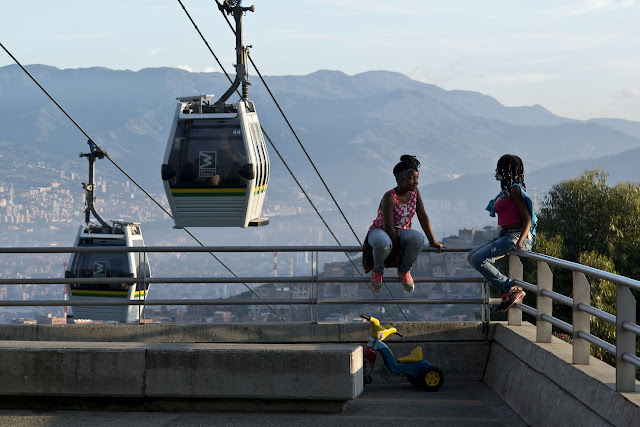
The gondola/metrocable system in the San Javier neighborhood (Comuna 13.)

It’s a beautiful Saturday afternoon—every day seems like spring in Medellín, where daytime temperatures hover in the seventies the entire year. Carolina Andrea Ramírez, a high-energy thirty-four-year-old single mother of Afro-Indigenous descent, is taking us on a tour of Comuna 8 in the city’s eastern hills.

Medellín, whose 2.4 million residents make it Colombia’s second largest city, has sixteen Comunas, or sections of the city. Comuna 8, with a population of about 135,000 people, is one of the poorer sections.

Ramírez was born in Comuna 8, lived on the streets from fourteen to twenty-eight years old, and now lives again in Comuna 8 with her mother and two teenage sons. About a year ago, she formed a local nonprofit, Corazón de Leon (Heart of the Lion), which focuses on “providing another option than drugs for young people,” such as art, music, sports, and Saturday afternoon classes.

On this particular day, we meet Ramírez beneath the construction of a gondola transit system that is to begin in Comuna 8 next year. We walk up, the roads giving way to stairs, which give way to dirt paths. As we hike, we pass homes that many might dismiss as shanties. Before long we enter a green-belt area with “eco-parks,” playgrounds, organic garden plots, and a cobblestone-like path to the top of a hill known as Pan de Azúcar (Sugar Bread), which has one of the best views of Medellín.

The projects are part of El Jardín Circunvalar, loosely translated as The Circular Garden, which in turn is part of a green belt being built in Medellín’s hills. As we walk, I try to think of a similar, multi-faceted project in a poor Milwaukee neighborhood, especially a publicly funded and controlled project. I can’t.

What come to mind are the Civilian Conservation Corps projects of the New Deal. Like those projects, El Jardín Circunvalar focuses not just on the final project, but on providing jobs; of the roughly 780 people employed in building the project, 600 were neighborhood residents. The plaque commemorating the opening of an eco-park in Comuna 8 lists not just the usual government officials involved, but also the names of the workers.

Three years ago, the eco-parks, playgrounds, garden plots, and stone path to Pan de Azúcar did not exist. They reflect what is termed “social urbanism” in Medellín, which refers to comprehensive, holistic public projects that link public transit to green-space to libraries, cultural projects, parks, sports facilities, schools, and daycare centers.

These efforts have drawn international recognition, including a 2013 “Green Prize” from the Harvard Graduate School of Design and a 2012 “Innovative City of the Year” award from the Wall Street Journal and Citi. But what makes Medellín stand out is that its most ambitious projects have been in poorer neighborhoods.

Government-sponsored websites explain the city’s projects, invariably in glowing terms. But I wanted to get the perspective of a local resident. Bob and I return to Comuna 8.

As we sit on a hill overlooking Medellín, Ramírez explains that “everything in Medellín is very complicated.” Echoing a widely held belief in a country infamous for political corruption, she believes that all politicians “are rats.” The difference, she says, “is that in Medellín the rats are also doing good things.”

Asked for specifics, she mentions improvements in education, in daycare centers for working mothers, in public parks, in the gondola that is being built. “Most of the people in Comuna 8 work far away, so the transit is very important,” she says.

But, she adds, it’s more than the specific projects; her experience living on the streets taught her the importance of believing in a better future. “Now,” she says, “there is more hope. There are smiles on the faces of the children.”

Carolina Ramírez in the hills of Comuna 8, overlooking Medellín.


When Pablo Escobar was killed in 1993, Medellín was in disarray. Besides the violence, the city was sharply segregated. Entire neighborhoods were considered “no-go zones,” dangerous for residents and visitors alike. There was a growing consensus that Medellín, an industrial and economic linchpin of the entire country, had to change.

The push for a new Medellín got a significant boost with the opening of the metro in 1995. But the election of reformer Sergio Fajardo as mayor in 2003 was a watershed, and Fajardo has become an iconic symbol of Medellín’s transformation. Even today, political candidates seek votes by proclaiming: “I am a Fajardista.”

Fajardo is a charismatic professor and journalist turned politician who graduated from the University of Wisconsin-Madison with a doctorate in mathematics in 1984. He was elected as part of a civic movement independent of the major parties.

Fajardo’s status is partly due to the pace of change during his mayoral term from 2004 to 2007, before he went on to become governor of the state of Antioquia. Most important, Fajardo and his civic movement disrupted the normal way of doing business in Medellín. They weren’t interested in showcasing architecture or splashy projects designed to give Medellín a new international image. They saw architecture, design, and innovation as tools of social transformation.

Upon taking office, Fajardo highlighted three main problems: inequality, violence, and a culture of corruption. He pledged a commitment to education, transparency and anti-corruption, and the importance of public spaces and civic involvement. “Our most beautiful buildings must be in our poorest areas,” he noted.


The electric escalators in Comuna 13.
Some of the many projects initiated during Fajardo’s administration include rebuilding the city’s Botanical Gardens (which are free); building and renovating schools; expanding public parks and plazas; completing and extending the gondola system; and developing library parks, which combine libraries with green space, a concept that has since spread to other Latin American countries. Many of the projects were developed with input from publicly funded community councils.


One of the many murals in the areas surrounding the escalators.


Homes in Comuna 13, just above the escalators.
In Medellín’s San Javier district, up the hill from the metro station in Comuna 13, is a library park “Parque Biblioteca Presbítero José Luis Arroyave,” named after a priest who advocated for peace and was gunned down by paramilitary forces in 2002. Murals along the street give way to a winding path and green space, which give way to an organic garden, sculptures and, at the top, the library’s entrance. Inside, the complex is part library and part community center, with initiatives ranging from young children’s art projects to an oral history project involving long-time neighborhood residents.

Today, Comuna 13 is known for its range of innovative public projects. But it has a darker history. In a country where military/paramilitary/rebel/gang/drug violence has been the norm for more than half a century, the neighborhood holds special significance as the site of Colombia’s most infamous military invasion of an urban area—Operation Orion, in 2002.

At the time, Comuna 13 lacked even the pretense of government control. Leftwing rebels had gained a foothold and provided a semblance of oversight, but were constantly under attack from military and right-wing paramilitary forces. In October 2002, Colombia’s conservative president ordered a military offensive to oust the rebels. Thousands of soldiers and police attacked, supported by armed helicopters in the air and paramilitary forces on the ground. The area’s roughly 100,000 residents were caught in the crossfire. After a week of intense fighting and house-to-house searches, right-wing paramilitaries took control of the neighborhood.

No one knows exactly how many people died in the attack and its aftermath but figures range upwards of seventy people. Several hundred were injured, many of them civilians. During and after the offensive, the paramilitaries adopted a practice of “disappearing” people suspected of leftist sympathies. Estimates of “disappeared” civilians range as high as 300 people.

Today, Comuna 13 is home to not only the library park but also the metro, gondola, escalators and increased social, education and cultural services. Street-level murals at the base of the library park speak to the neighborhood’s history. The art is stunning and the messages are clear. “No more military intervention,” says one mural. “We are Comuna 13, where memory and life are present,” says another. Referring specifically to the disappeared, one of the murals pointedly asks: “Where are they? Truth, justice, and reparations.”


Murals near the Library Park in Comuna 13

Comuna 13 is just one example of how the Medellín of 2015 is significantly different from the Medellín of 1995. Foreign investors have taken note. Adding to Medellín’s history as an industrial center, the city’s tech sector is now the third largest in Latin America. Hoping to take advantage of Medellín’s increasingly educated but still low-paid workforce, companies such as Google, Facebook, and IBM have set up shop.

Some critics have dismissed Medellín’s changes as window-dressing that leaves basic structures intact. Cocaine is still a big business. Unemployment, drugs, and gangs remain huge problems. Poverty has decreased, but the gap between the rich and poor has increased.

Still, there is no denying the progress and the disruption of business as usual. And at a time when privatization and public dollars for private projects dominate government initiatives across the globe, Medellín is an anomaly.

Where will it lead? Nobody knows for sure. For now, Medellín’s past and the promise of a new future co-exist; the outcome is not clear.

San Antonio Plaza, in the city’s downtown, provides an apt symbol.


Botero's two birds in the San Antonio Plaza in downtown Medellín.

In 1995, a bomb was placed in the plaza inside a ten-foot bird sculpture by Fernando Botero, a well-known Medellín artist. The bombing killed an estimated thirty people who were attending a music festival at the plaza and injured hundreds more. No one claimed responsibility and no one was ever arrested.

The destroyed artwork was left standing, a reminder of Medellín’s history of violence. In 2000, Botero made a new sculpture similar to the original, calling it “Homage against Stupidity.” The two birds stand side by side.


Barbara Miner is a Milwaukee-based writer and photographer.

This article originally appeared in the December-January issue of The Progressive magazine. The Progressive has been writing about issues of peace and social justice since 1909. To subscribe, go to: www.progressive.org